Vinsanto: Santorini’s Volcanic Elixir
By Yiannis Karakasis MW
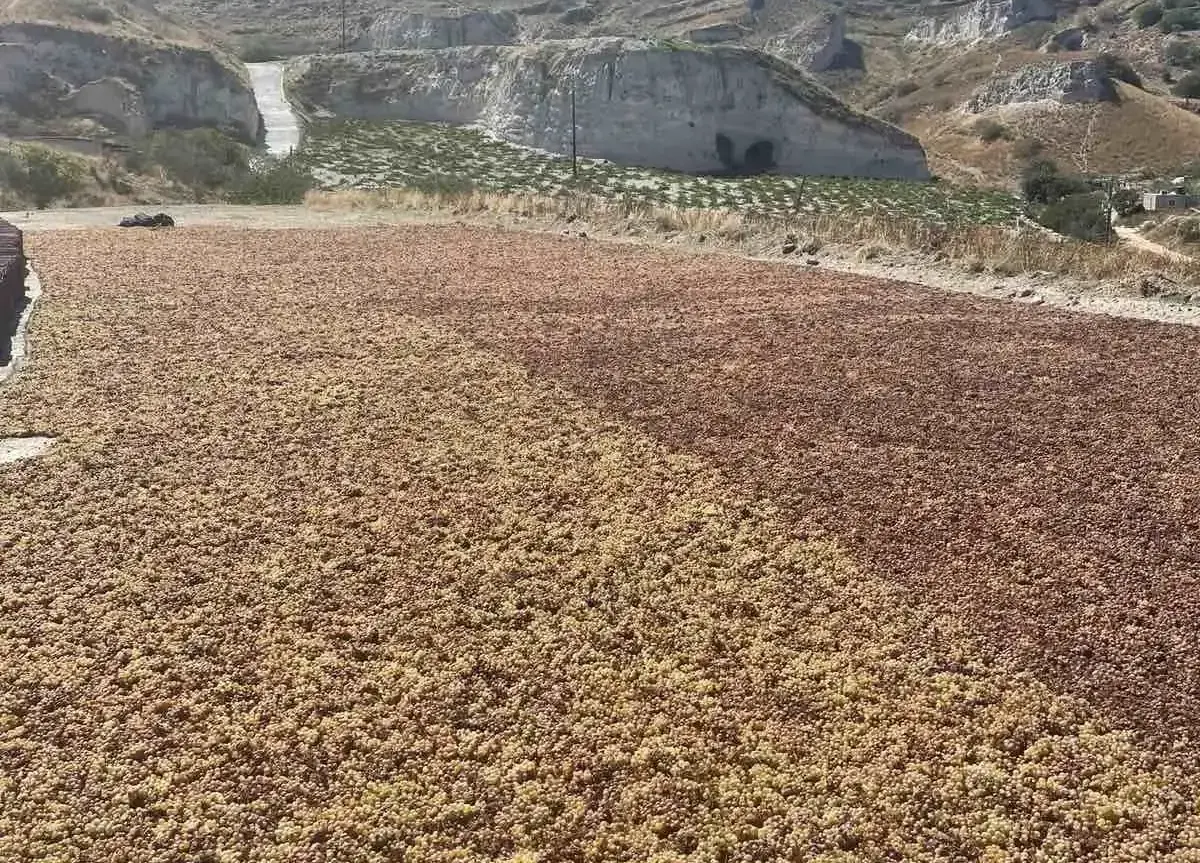
Santorini is more than just a place for wine. It is a meeting place of elemental forces: earth, wind, and fire. Vinsanto perhaps best captures the true character of this unique volcanic terroir. A sun-dried wine of notable concentration and depth, it is produced through methods that seem almost timeless. Grapes are laid out under the Aegean sun for about ten days, then moved into shade for another four or five, before slowly fermenting. Each producer adds their own nuances, but these are the basics. The wine is then aged in barrels until it acquires its distinctive amber colour and layered aromas of dried fruit, honey, nuts, and saline complexity.
In many ways, it is a liquid reflection of the sea and volcanic earth.
History
The story of wine on Santorini reaches far back into prehistory. Finds from Akrotiri, including pithoi and frescoes, point to the presence of the vine as early as the 17th century BC. The island’s soils, rich in pumice and volcanic ash and poor in organic matter, produce wines of striking concentration and naturally high acidity. These are wines shaped by scarcity, wind and sun, wines with intense personality and staying power.
One of the most compelling explanations for the name Vinsanto places its origins in the Venetian era, when the sweet wine of Santorini was referred to as Vin Santo by Venetian merchants, at a time when the island itself was known as Santo Erini, later Santorini. In this reading, the term effectively meant wine from Santorini. This was precisely the name under which the wine was sold in international markets during the 18th and 19th centuries.
In the Byzantine period, sweet wines from Thira are mentioned in monastic records and fiscal documents. Later, Vinsanto became a wine of international fame, exported to Russia and Venice alike. It was used in religious ceremonies, but it also served as a significant commercial commodity. In that sense, it carried a double identity, sacred and commercial at once.
Assyrtiko and kouloura
Vinsanto begins with Assyrtiko, the iconic grape variety of Santorini, although its presence here is more subtle than in the island’s dry wines. Legislation requires a minimum of 51% Assyrtiko, compared to the 85% required for the dry category, allowing for varieties such as Aidani and Athiri. Aidani, in particular, can boost aromatic brightness and softness, adding another layer to the final blend.
The vines are trained in the renowned kouloura method, woven into low circular baskets that shield the fruit from strong winds, drought, and heat. In Santorini, the kouloura is both a symbol and a necessity, demonstrating how landscape and human adaptation have become deeply interconnected.
Production and ageing
After sun-drying, which generally lasts around fifteen days, the grapes are dehydrated and become intensely concentrated in both sugar and acidity. Fermentation progresses slowly and can take several months, sometimes even longer. Maturation in oak barrels lasts at least 24 months, although many producers age their wines for much longer, enhancing their depth, density, and complexity.
In earlier times, grapes were dried directly on the ground. The volcanic soil absorbs the morning's humidity and quickly releases it (evaporates), helping prevent mould. It was not just theory but inherited wisdom, shaped by generations of close observation.
What makes Vinsanto so compelling is that sweetness alone never reveals the full story. Residual sugar can reach 300 grams per litre or more, yet the wine is rarely cloying. Its naturally high acidity keeps it lively, vibrant, and fresh. When at its best, Vinsanto combines power with energy and sweetness with precision. Its aromatic spectrum is extraordinary: raisin, dried fig, walnut, honey, coffee, honeycomb, caramel, chocolate, and often an iodine edge that seems to bring the sea back into the glass. It is a wine of flavour, but also of texture and tension.
Challenges and a comeback?
Sweet wines are quietly making their way back to the table. They may not be everyday bottles, but they are increasingly earning a place in serious gastronomy, alongside aged cheeses, spicy dishes or simply at the end of a meal when conversation matters more. Yet production remains under pressure. It takes roughly seven to ten kilos of grapes to produce one litre of Vinsanto, while tourism continues to pull land away from the vineyard. On top of that, reduced production in vintages such as 2023, 2024 and 2025 has left very little room for sweet wine, since almost all available fruit has been absorbed by the dry wine category.
That is one of the reasons Vinsanto deserves renewed attention. It is not only one of Greece’s great wines, but one of the world’s distinctive sweet wine styles. It combines history, terroir, structure and longevity in a way that very few wines can.
Below are some classics according to their style
Up to 8 years in oak
Subscribe to Continue Reading
This premium blog post is restricted. Subscribe to get access to all blog posts and unlock our complete library of Greek wines, varieties, and expert insights.
- Email updates (1–2 / month)
- Access to free posts
- Special subscription offers
Aficionado
For enthusiasts and trade professionals who want full article access
Subscribe Now- Full access to all subscriber-only posts
- Full access to wine reviews and grape varieties sections
- Executive summaries for major features/reports
- Reliable, focused information on Greek wine, in an international voice
Aficionado Premium
For advanced readers, sommeliers & buyers needing deep documentation
Go Premium- Everything in Aficionado, plus:
- Full access to all Reports (9 to date)
- Access to approximately two new reports per year
- Executive summaries for major features/reports
- Reliable, focused information on Greek wine, in an international voice
Professional
For importers, retailers, restaurants, producers, and trade press
Get Professional- Everything in Aficionado Premium, plus:
- Publication rights for reviews and short tasting notes (up to 50 words)
- Article excerpt rights (up to 120 words, up to 3 excerpts/month)
- Priority support (email) for usage/attribution questions
- Mandatory attribution required with active link where possible
Already have an account?
Sign in here